
- Posts: 4
- Thank you received: 0
 test strips
- Vitalii
-
 Topic Author
- Offline
- New Member
-

Less
More
23 May 2013 21:28 #33343
by Vitalii
test strips was created by Vitalii
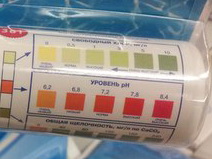
Hello everyone! Recently I made a CDS by short glass method. But I have a feeling that the concentration is greater than 3000 ppm. Here in Russia, I can not buy test strips that allow to determine the amount of chlorine dioxide in solution. I found strips which can determine only the amount of "free chlorine" in the water. Only six gradations on a scale of 0 to 10 mg per liter. Is there any way to determine the concentration of some CLO2 in the solution of such a test strip? How to do it? Do I understand correctly that 3,000 ppm - that's 3,000 parts per million of the substance, which is equivalent to 3 parts per thousand (ppm) = 3 grams per liter? Help, I'm confused)))
- JB13
-
- Offline
- Platinum Member
-

23 May 2013 23:12 #33348
by JB13
Replied by JB13 on topic test strips
Hello Vitalii.
Yes, 1 liter of 3000 ppm CDS contains 3000 mg or 3 grams of ClO2.
I use free chlorine DPD-1 reagent strips in a photometer which will read out a percentage number. Using a ClO2 chart for my photometer, the percentage number is found on the chart and the ppm is then known. Of course, you would need a photometer.
You can buy LaMotte high range tests online. Here are two links:
wps4sale.com/store/misc-supplies/chlorine-dioxide-test-strips-detail
www.amazon.com/Test-Strip-Chlorine-Dioxide-Pk/dp/B007IBORSK/ref=pd_sim_sbs_indust_1
You will need to dilute your test solution so the ClO2 test strips can read within their 0-500 ppm range. It is best to read mid-range so your eye can see color differences more easily. If you think you have 3000 ppm CDS, try diluting 1 part CDS to 60 parts distilled water. Be sure to use distilled water or you may not get accurate results.
Yes, 1 liter of 3000 ppm CDS contains 3000 mg or 3 grams of ClO2.
I use free chlorine DPD-1 reagent strips in a photometer which will read out a percentage number. Using a ClO2 chart for my photometer, the percentage number is found on the chart and the ppm is then known. Of course, you would need a photometer.
You can buy LaMotte high range tests online. Here are two links:
wps4sale.com/store/misc-supplies/chlorine-dioxide-test-strips-detail
www.amazon.com/Test-Strip-Chlorine-Dioxide-Pk/dp/B007IBORSK/ref=pd_sim_sbs_indust_1
You will need to dilute your test solution so the ClO2 test strips can read within their 0-500 ppm range. It is best to read mid-range so your eye can see color differences more easily. If you think you have 3000 ppm CDS, try diluting 1 part CDS to 60 parts distilled water. Be sure to use distilled water or you may not get accurate results.
The following user(s) said Thank You: pam
Please Log in or Create an account to join the conversation.
- Tomas
-

- Offline
- Junior Member
-

Less
More
- Posts: 36
- Thank you received: 77
24 May 2013 10:37 #33356
by Tomas
Replied by Tomas on topic test strips
Hi Vitalii,
with no warranty, but it is probable that you get the ClO2 concentration when you multiply "free chlorine" result by 1.9 coefficient. Needs to be verified using LaMotte test strips or photometr!
Tomas
with no warranty, but it is probable that you get the ClO2 concentration when you multiply "free chlorine" result by 1.9 coefficient. Needs to be verified using LaMotte test strips or photometr!
Tomas
The following user(s) said Thank You: JB13
Please Log in or Create an account to join the conversation.
- trodan
-
- Offline
- New Member
-
Less
More
- Posts: 8
- Thank you received: 1
26 May 2013 00:53 #33384
by trodan
Replied by trodan on topic test strips
Does anyone know where I might get the test strips from here in Australia? I have tried online, but all I am finding is overseas suppliers, and Amazon won't post to Australia. Others also. I have paypal money and have looked on ebay...nothing. Is there somewhere like a shop the church runs, where I can purchase these types of things?
Please Log in or Create an account to join the conversation.
- james11007
-
- Offline
- New Member
-
Less
More
- Posts: 1
- Thank you received: 0
27 May 2013 06:57 #33404
by james11007
Replied by james11007 on topic test strips
HI ,
please check with your restaurant supplies stores ,
they will have the test strips ,
as the kitchen help use them.
James
please check with your restaurant supplies stores ,
they will have the test strips ,
as the kitchen help use them.
James
Please Log in or Create an account to join the conversation.
- Tbox
-
- Offline
- User is blocked
-

Less
More
- Posts: 11
- Thank you received: 3
26 Jul 2013 10:17 #34894
by Tbox
Replied by Tbox on topic test strips
REFERENCE:
Place 60 ml of distilled water into a small clean glass. Add 1 ml of your CDS to this water. Dip the test strip into the water for 2 seconds. Pull out and wait 10 seconds. Check the color against the range on the test strip bottle. Multiply the number corresponding to the closest color by 60 to get the parts per million (ppm). If the color matches the 50 then you have 3000 ppm. If it is in between the 50 and the 100 then you have 4500 ppm and so on.
FYI
Place 60 ml of distilled water into a small clean glass. Add 1 ml of your CDS to this water. Dip the test strip into the water for 2 seconds. Pull out and wait 10 seconds. Check the color against the range on the test strip bottle. Multiply the number corresponding to the closest color by 60 to get the parts per million (ppm). If the color matches the 50 then you have 3000 ppm. If it is in between the 50 and the 100 then you have 4500 ppm and so on.
FYI
Please Log in or Create an account to join the conversation.
- pep13
-
- Offline
- New Member
-
Less
More
- Posts: 4
- Thank you received: 0
08 Aug 2013 17:32 #35175
by pep13
Replied by pep13 on topic test strips
Hi:
My question is concernig a higher concentration in my CDS, over 500 ppm in the test. How do I possibly know the excact concentration if it's over the kit range ?
Is it posible to dilute my CDS ?...and how.
Thanks.
Pep
My question is concernig a higher concentration in my CDS, over 500 ppm in the test. How do I possibly know the excact concentration if it's over the kit range ?
Is it posible to dilute my CDS ?...and how.
Thanks.
Pep
Please Log in or Create an account to join the conversation.
- JB13
-
- Offline
- Platinum Member
-
08 Aug 2013 22:53 #35181
by JB13
Replied by JB13 on topic test strips
Tbox has the answer for you in the post just above yours.
The following user(s) said Thank You: pep13
Please Log in or Create an account to join the conversation.
Time to create page: 0.316 seconds

The MMS HEALTH RECOVERY GUIDEBOOK is Jim’s latest book. It provides the latest information on how to safely use MMS. Click the book image to order your copy today.
Jim's Blog
-
Why it’s Not Working
Published on: September 2, 2026
From a discussion with Jim on why MMS/CD doesn’t seem to be working: Jim: If it’s not working, do something different. But this can be tricky, you have to give each thing enough time to work, don’t be rash, but don’t stay stuck either, this is where listening to your body comes in and the …
-
Important Safety Tip on Mixing a Dose
Published on: August 17, 2026
Recently it has come to our attention that some people question if you need to take an MMS/CD dose in water. The answer is a big YES! All MMS (chlorine dioxide) doses, with whatever “variation” of MMS/CD one is taking, needs to be mixed in water. You NEVER take it straight. The standard is usually …
-
How does MMS affect bacteria in the body?
Published on: July 24, 2026
First facts, MMS does not kill friendly bacteria. What is the difference in useful bacteria and the harmful stuff? Well the feces of the useful bacteria is not poisonous and the feces of the harmful bacteria is poisonous and that is what makes one sick and causes the problems. Poisons have long chains of atoms …
-
MMS/CD and Plastics
Published on: July 12, 2026
Question: How does MMS interact with various plastics? Jim: In regards to your question about plastics, we really cannot give you a “sure bet” answer. This is because the world of plastics is vast, and like so many things in our environment, it’s difficult to know what is really what. To give you an idea, …
-
MMS/CD, Bacteria and Viruses
Published on: July 5, 2026
Question: Does MMS/CD kill bacteria and virus? Jim: Antibacterial drugs can sometimes stop bacterial [infections] diseases but medicine has yet to develop anything to stop viral infections. Thankfully, MMS/CD has been known to stop both viral and bacterial diseases. For either viral or bacterial infections, begin with the Starting Procedure and continue following the Health …
-
Importance of Following the Plan
Published on: June 27, 2026
Every week at least one new person approaches me with the question will MMS/CD help overcome some new disease. MMS/CD is an oxidizer that fits into the operation of the body in the exact right chemical balance to kill diseases and their poisons and eradicate heavy metals. Drugs must somehow attack the nucleus of the …